
Cash Is King: Why Cash Flow, Not Net Worth, Keeps You Solvent
Cash is king because cash flow, not net worth, is what keeps you solvent. The real difference between cash and wealth, what insolvency actually means, and why leverage demands cash to survive.
Cash Is King: Why Cash Flow, Not Net Worth, Keeps You Solvent
Why Is Money Life's Greatest Enabler?

Ask ten people what they want more of, and nearly all of them will say money. Ask why, and the answers get vague fast: security, freedom, options. That vagueness is worth sitting with, because it points at something true. A pile of banknotes cannot feed you, drive you to work, or fix a leaking roof. Money is only ever a means, the universally accepted medium of exchange, and what it actually buys is access.
Access to where you live, what you eat, the work you choose to do, and how you spend your time. Access to education, healthcare, and technology. Underneath all of that is a simpler idea: money is what lets you make decisions instead of just absorbing whatever happens to you. That is the entire case for paying attention to it.
Cash Is King, but Wealth Is Not the Same Thing
Here is where most people get tripped up. They treat "money" as one idea, when it is actually two very different things wearing the same name.
Cash is what you can spend today: the balance in your bank account, physical notes in your wallet, anything that converts into a payment within minutes. Cash covers day-to-day expenses, emergencies, and anything due this week.
Wealth is a bigger, slower idea. It is the value of everything you own, property, investments, superannuation, minus everything you owe. Wealth can be substantial and still be almost entirely out of reach.
Take an ordinary example. You own a home worth $1 million, you owe $700,000 on the mortgage, and you have $500 in the bank. Do the math and your net wealth is $300,500. That number looks comfortable. It also has almost nothing to do with whether you can pay for dinner tonight, because dinner is never paid for in home equity.
Whatever the number on your balance sheet says, food, rent, fuel, and school shoes all get paid for the same way: with cash. That is precisely why managing cash well is not a side activity. It is the actual mechanism through which everything else gets done, including building the wealth number in the first place. That is the real content of the phrase "cash is king": the spendable balance, not the balance sheet, is what decides whether you stay afloat. Why is cash king? Because it is the only form of money that can actually pay a bill the moment one arrives, net worth cannot.
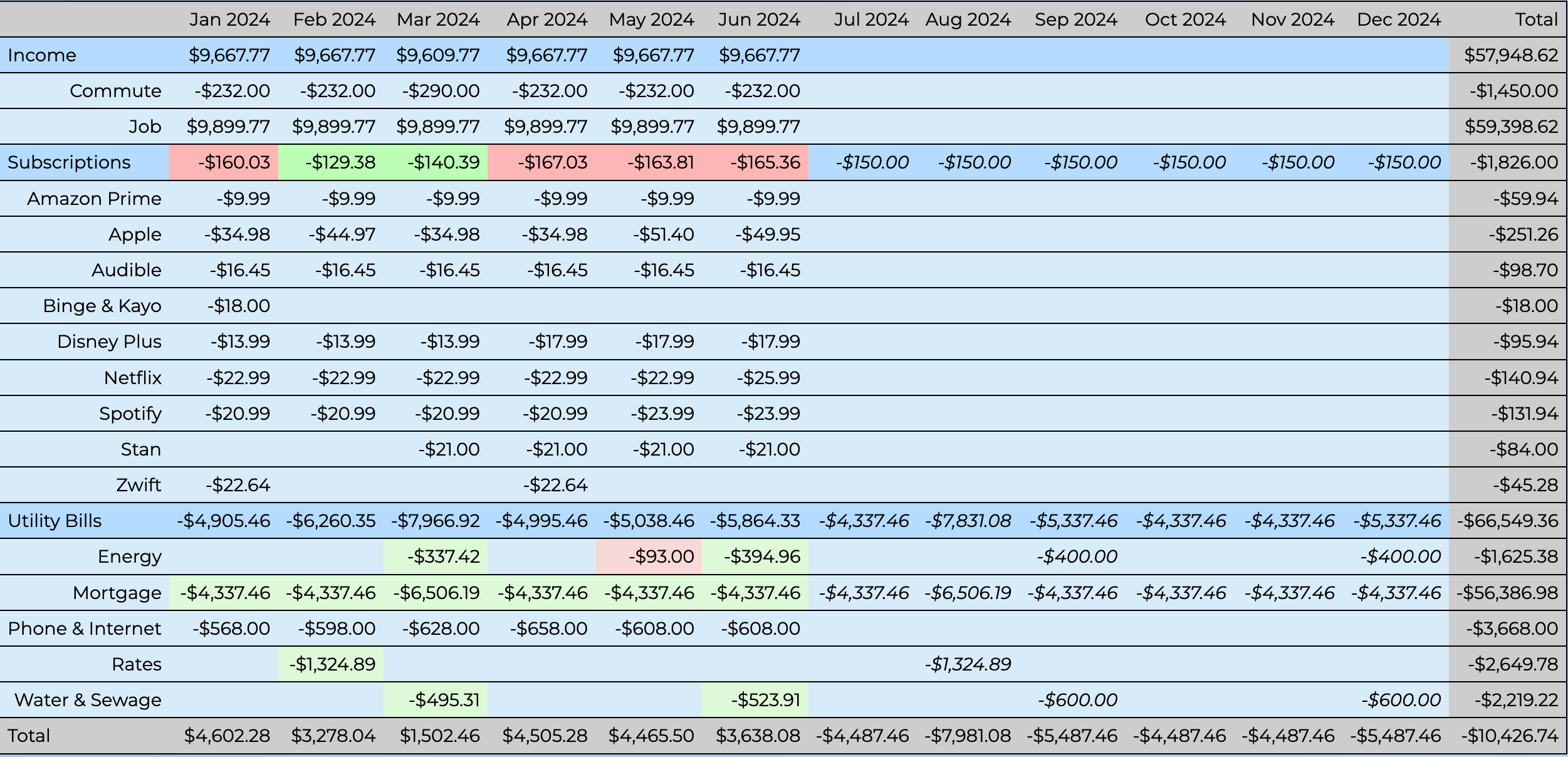
Because these two things answer different questions, this website tracks both of them separately rather than blending them into one number. The Net Worth Tracker shows what your assets are worth over time. The Cash Flow Table shows what is actually moving through your accounts, and that includes your debt: a mortgage or loan repayment is a transaction like any other, so its effect on your cash position shows up there automatically, month after month. Neither view substitutes for the other, and conflating them is exactly how people end up surprised.
TOO MUCH
What Is the Case Against Holding Too Much Cash?
It would be reasonable to assume the safest move is simply to hold as much cash as possible. It is not, and the reason is one of the more counterintuitive ideas in personal finance.
Cash sitting in an account is a genuinely poor long-term investment. Inflation quietly erodes its value every year it just sits there, so $10,000 doing nothing today buys measurably less in five years' time. Cash was never meant to be the destination. It is raw material, something you convert into things that actually generate a return: shares, property, a business.
That word, return, matters more than it sounds like it should. A genuine investment has to produce something back, income, growth, or both. If it does not, it is not really an investment, it is spending that happens to leave you with an object afterwards. A garage full of cars nobody drives is not an investment because they look good sitting there. A share portfolio paying dividends and growing in value is. The distinction is not semantic, it is the entire reason cash gets deployed into anything at all.
This is also why the Net Worth Tracker exists as its own thing on this website, separate from the Cash Flow Table. Once cash has been converted into a house, shares, or a business, you want to watch that value build over time, and that is a different job to tracking the cash moving through your accounts week to week.
TOO LITTLE
What Is the Case Against Holding Too Little Cash?

So hoard less and deploy more? The opposite failure is the one that actually ruins people, and it is more dangerous precisely because it looks like success right up until it does not.
You can be entirely asset-rich, a paid-down house, a share portfolio, a thriving small business, and still go bankrupt. The mechanism is almost mechanical. If you have borrowed money to buy any of those assets, the loan does not get serviced with your net worth, it gets serviced with cash, specific amounts, on specific dates, every month. A bank does not care what your investment property could theoretically sell for next year if you cannot make this month's repayment. Leverage magnifies wealth on the way up and demands cash on the way down, and it only ever asks for one of those two things.
Which is why insolvency has almost nothing to do with how much you earn. High earners run out of cash just as easily as anyone else, sometimes more easily, because bigger incomes tend to arrive with bigger, more leveraged obligations attached. The failure point is never the income statement. It is the bank account, on the specific day a payment is due.
This is the exact blind spot the split between the Net Worth Tracker and the Cash Flow Table is built to catch. Your asset value can be climbing steadily in the Net Worth Tracker while the loan behind it is quietly dragging your cash position down in the Cash Flow Table, because that is where debt actually lives, in the repayments leaving your account, not in the asset's valuation. If you are only glancing at the first number, everything looks fine right up until it is not.
I often joke with my kids, calling them "broke-ass-broke." They have no real money, but they also have no debts, so for them it is not really a big deal. For my wife and me, it is a different story. If we run out of cash, there is no food on the table, no fuel in the car, no clean clothes. Having debts is what turns a cash shortfall from an inconvenience into an emergency.
Are Insolvency and Bankruptcy the Same Thing?

The two words get used interchangeably in casual conversation, which is worth correcting, because they describe different things.
Insolvency is a financial state: being unable to pay your debts as and when they fall due. It can apply to a person or a company, and by itself it is not a legal event, it is simply a description of where your cash flow currently stands.
Bankruptcy is what can follow. In Australia it is a specific legal status that applies to individuals, administered by the Australian Financial Security Authority under the Bankruptcy Act 1966, and it is only one of several formal paths available to someone who is insolvent, alongside options like debt agreements and personal insolvency agreements. Companies do not technically "go bankrupt" under Australian law, they go into liquidation or administration instead, a different process regulated by ASIC rather than AFSA. The word gets borrowed loosely for struggling companies in everyday speech, but it is not the correct term.
Recognizing insolvency early, while it is still just a cash flow problem, is what gives you options. By the time it becomes a legal one, most of those options have already closed.
Why Banks Only Lend to People Who Do Not Need It
There is an old joke among lenders that happens to be entirely true: banks do not lend money to the people who need it most, they lend it to the people who can prove they will pay it back. As you get closer to insolvency, your risk to a lender goes up and your borrowing options shrink at exactly the moment you would want them to widen.
The practical lesson is almost annoyingly simple. Arrange finance well before you need it, not while you are already underwater. A loan applied for from a position of strength tends to get approved. The same loan applied for from a position of desperation usually does not, and that gap is precisely where people get stuck.
Why Lenders Never Lend the Full Value of an Asset
This is also why lenders almost never lend the full value of whatever you are borrowing against. When you take out a loan secured by an asset, a house, a car, a piece of equipment, you are offering that asset as collateral: if you stop paying, the lender has the legal right to seize and sell it to recover what it is owed.
The problem, from the lender's side, is that a forced sale rarely recovers full value. A rushed sale, under time pressure, in whatever market conditions happen to exist at that moment, tends to fetch less than a calm, well-marketed one. So lenders build in a buffer, commonly called a haircut, and lend less than the asset is actually worth.
Buy a $100,000 property and a bank might lend $90,000, requiring you to fund the remaining $10,000 yourself. If you default and the property is sold for $91,000, the lender takes the $90,000 it is owed, plus costs. What happens to the leftover $1,000 depends on exactly where you stand legally. Outside formal bankruptcy, it is generally returned to you. Once you are formally bankrupt, Australian law actually directs that surplus into the bankrupt estate, where a trustee distributes it among your other creditors first. Either way, the lender was never exposed to the full value of the asset, and that gap is the haircut doing its job.
How Can You Earn a Lot and Still Go Bankrupt?
Earning lots of money does not mean you will not become insolvent. All of these people earned a fortune, ran out of cash and went bankrupt.
Should You Track Both Cash and Wealth?
Every person in that grid had a wealth number that looked fine, sometimes spectacular, right up until a cash number quietly ran out from underneath it. That is not a coincidence, it is the same failure repeating itself with different names attached. "Cash is king" is the four-word version of it.
It is also the reason this website deliberately keeps two separate views of your money rather than folding everything into a single figure. The Net Worth Tracker answers a slower question: what is the value of what you have built. The Cash Flow Table answers the question that actually determines solvency: what is moving through your accounts, month by month, including every loan and mortgage repayment leaving on schedule. Debt does not sit quietly on the asset side waiting to be netted off once a year, it shows up as cash leaving, every single month, whether or not you are watching. Watching only the wealth number is how a Kim Basinger or a Dennis Rodman moment happens, not because the money disappeared, but because nobody was watching the number that actually mattered at the time it mattered.
Frequently Asked Questions
What is the difference between cash and wealth?
Cash is what you can spend right now: your bank balance, physical notes, anything that converts into a payment within minutes. Wealth is the value of everything you own minus everything you owe, and much of it is not liquid. You can have substantial wealth on paper and still be unable to cover this week's bills, because bills are only ever paid in cash.
What is the difference between insolvency and bankruptcy?
Insolvency is a financial state, being unable to pay your debts as and when they fall due. Bankruptcy is a formal legal status that can follow it. In Australia, bankruptcy applies to individuals and is administered by the Australian Financial Security Authority under the Bankruptcy Act 1966; companies do not technically go bankrupt, they go into liquidation or administration instead, regulated by ASIC.
Why do lenders lend less than an asset is actually worth?
Because a forced sale rarely recovers full value. If you default, the lender has to sell the asset under time pressure, in whatever market conditions exist at that moment, and that typically fetches less than a calm, well-marketed sale. Lenders build in a buffer for that gap, commonly called a haircut, by lending less than the asset's assessed value in the first place.
Why do people say cash is king?
The phrase is usually used loosely, to mean hold cash, or pay in cash. The useful version is narrower: your spendable cash position, not your net worth, is what decides whether you can meet your obligations as they fall due. Wealth that cannot be turned into a payment this week does not help you this week.
Further Reading
 BlogBetter Money Management Using Cash Flow TablesWhat a cash flow table is, how to build one, and why it beats a cash flow spreadsheet for staying on top of your money.Read article
 BlogHow Much Should I Have in My Rainy Day Fund?The three-to-six-months rule is a number for an average person who does not exist. How to size a rainy day fund from your own risks, and why the fund is only one of three defences.Read article
 SolutionWhen Can You Retire?A big net worth doesn't pay this week's bills, and it won't tell you when you can retire. Two numbers do: your passive income against your expenses, and how long your savings would cover the gap.Explore solution
Disclaimer: We are not financial advisers. The information on this website is general in nature and does not take into account your individual circumstances. You should seek independent professional advice before making financial decisions.